A group arrives with an idea
and no idea how to build it.
Schools, libraries, congregations, community organizations. You bring the idea and the people. I bring the plan, the materials, and twenty-five years of knowing what will hold.
What actually happens
The first session is not building. It is talking, drawing, and being honest about what a group of that size can finish in the time it has. A picture in somebody’s head is not yet a plan, and the gap between the two is where most community projects quietly fall apart.
Then comes the part nobody enjoys. Papier-mâché is slow. It is sticky, it is cold, and it takes days to dry. Kids especially will tell you, at length, that this is boring. That stretch is unavoidable and I have stopped apologizing for it, because of what happens next.
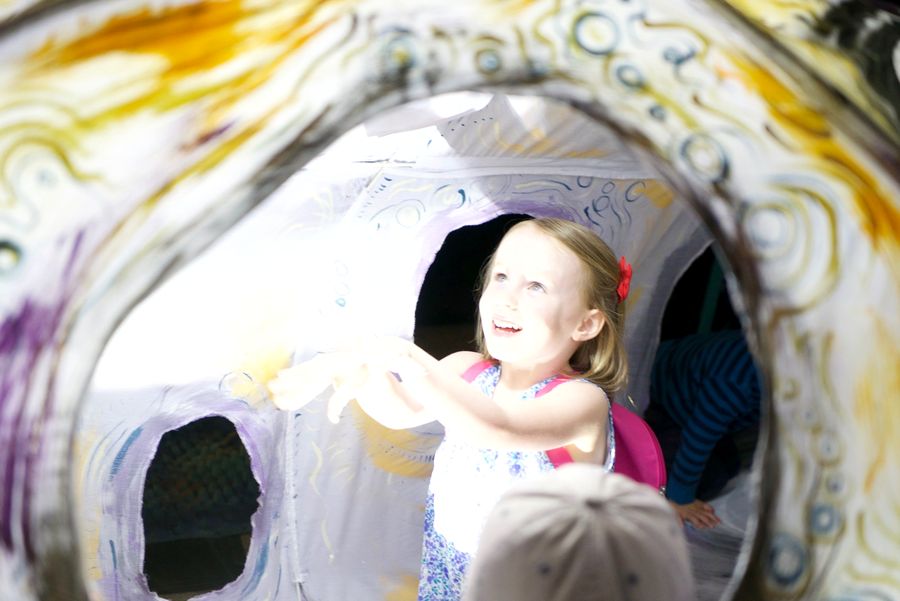
On the day, the group stands next to a thing they made, in front of a crowd, and the whole five weeks lands at once. They stop seeing a school project and start seeing an object that exists in the world because they decided it should. Nobody is bored on that day.
That is the real curriculum. Not the technique. The discovery that the built world is something you are allowed to add to.
Robin VanLear’s aim is to show people how much work goes into art.
CMA Thinker, 2018
Everybody offers suggestions. Nobody minds if you don’t take them.
The tent at Parade the Circle is the most generous room I have ever worked in. People wander between tables, look at what you are doing, and say what they would try. You take some of it and leave the rest, and nobody is offended either way. That is a rare thing and it is the model I run every workshop on.
Abington Arms, adults with physical disabilities, have taken part since the second year of the parade. They make their own costumes and they lead it. Twenty-plus years in, that is not outreach. That is the parade.
What a residency involves
-
A conversation before anything is promised
How many people, what ages, how many hours, what room, what day it has to be finished by, and what happens to it afterwards. I would rather tell you a thing is too ambitious in week zero than in week four.
-
A design the group actually made
Drawing sessions with the participants, not a design handed to them. My job is to find the version of their idea that can be built by the people in the room, in the time available.
-
A written plan
Materials, order of assembly, who does what, and how it comes apart. The same document I would write for a museum commission, in the same handwriting.
-
The build
Sessions with the group. I bring structure and salvage, and I stay out of the way as much as the deadline allows. Their hands, their piece.
-
The day
Parade, procession, opening, assembly. Whatever the ending is, it should be public, and the people who built it should be standing next to it.