The city, and how
the work grew out of it.
I came here for one parade in 2001 and I have been explaining this place to people ever since. Some of what I tell them.
A museum opened its doors and handed the city a pile of materials.
Robin VanLear brought the idea back from Santa Barbara, where she had been making art with first-graders for their own community. She returned to Cleveland in 1989 and ran a trial the following summer, 1990, as part of the Museum’s seventy-fifth birthday. Around a hundred and twenty-five people took part. The next year more than six hundred did.
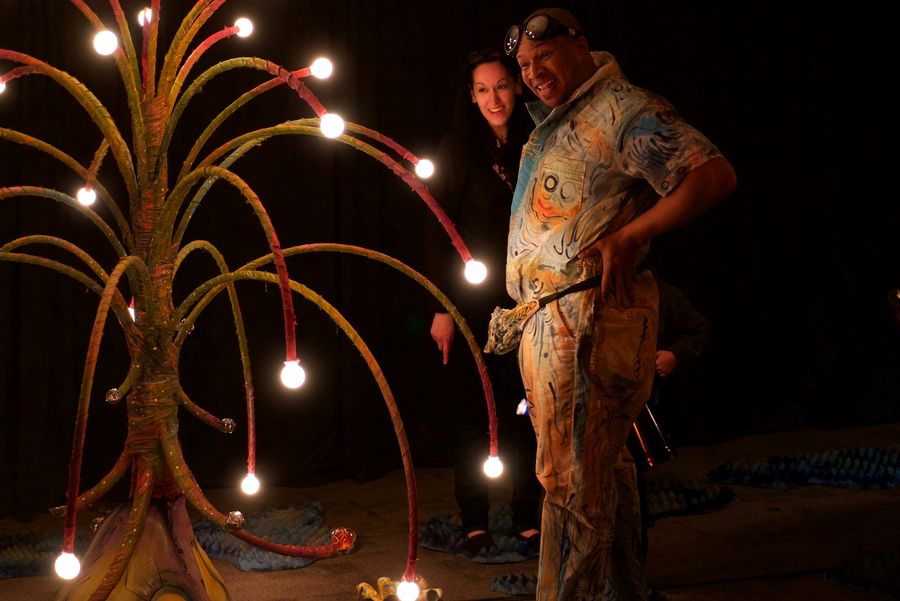
It has run nearly every year since. It starts at the Cleveland Museum of Art and goes counter-clockwise around Wade Oval, in University Circle. It was the twenty-ninth in 2018 and the thirty-third in 2025.
What makes it unusual is not the day. It is the five weeks before it. The Museum puts up a tent, fills it with materials, and lets anybody walk in: schools, congregations, neighborhood groups, families, people with no art training and no intention of getting any. Nobody is auditioned. What you make goes down the street next to what everybody else made.
I arrived in 2001 to assist Wendy Mahon, on a college friend’s recommendation, and built a giant dandelion in my first week. I moved here for good in 2005. I am the production manager now, which mostly means sitting with a group that has a drawing and no plan and working out how the thing will actually stand up.
A city that does this every June is telling on itself. It is saying that making things in public is normal here.
The first parade drew about a hundred and twenty-five people. The next drew six hundred.
Attendance figures from the Cleveland Museum of Art
The river caught fire, and that is the good part of the story.
The industries along the Cuyahoga made this the fifth largest city in the country by 1920, and they used the river’s last six miles as a place to put whatever they did not want. It caught fire more than once. The one in 1969 is the one that stuck, and it helped start the clean water movement that followed.
I think about that every time I work on a lantern parade. In 2026 I built a creature called Bessie with Eddie “Trash Fish” Olschansky, entirely out of recycled and upcycled material, and we walked it after dark along the Towpath Trail beside that same river, for Canalway.
A thing made of what people threw away, lit from the inside, carried along a river that once burned because of what people threw into it. I did not plan that. It is just what happens if you work here long enough.
A hundred and one miles on the path the mules walked.
The Towpath Trail follows the Ohio & Erie Canal along the route mules once walked while towing boats. Canalway Partners and the city have spent years building the final six miles of it through Cleveland itself, which is the hardest stretch, because that is where all the industry is.
That is the whole Cleveland move in one object. Nobody knocked the canal down and nobody pretended it was something else. They kept the path and changed what it is for.
Somebody decided the bridge should have figures on it.
The Hope Memorial Bridge opened in 1932 as the Lorain–Carnegie and carries almost a mile of road across the Cuyahoga. Four pylons, eight figures, each one cut from a forty-three-foot slab of Berea sandstone quarried down the road. Frank Walker designed the bridge; Henry Hering carved the Guardians.
Every one of them is holding a vehicle. A stagecoach, a covered wagon, a hay rack, four kinds of truck, a 1930s automobile. They are Art Deco, they are winged, and they are guarding traffic. The bridge was renamed in 1983. The baseball team is named after them.
I bring this up because it is the standard. A city in the middle of the Depression built a road bridge and then decided it needed eight forty-three-foot figures holding trucks. Nobody needed that. They did it anyway, out of local stone, and it is still there.
The foundry closed. The letters kept printing.
The Cleveland Type Foundry cast metal type in this city from 1875 until 1892, when it was folded into American Type Founders along with twenty-two other American foundries. The company disappeared. The type did not. It went into other people’s cases and kept working.
The headings on this site are set in a revival of an American Type Founders gothic from 1903, the condensed capital you see on bridges, freight cars and factory signs. The body is Caslon, which is what a jobbing printer reached for when in doubt. The plan blocks are typed, because a plan block is a work order.
None of that is decoration. It is the same argument the rest of my work makes: the thing already exists, it was built well, and it does not need replacing. It needs somebody to pick it up and use it for something.
More of these
There are a lot more. The Arcade. The West Side Market. What Playhouse Square looked like before. Why the lake matters. I will keep adding them here.